
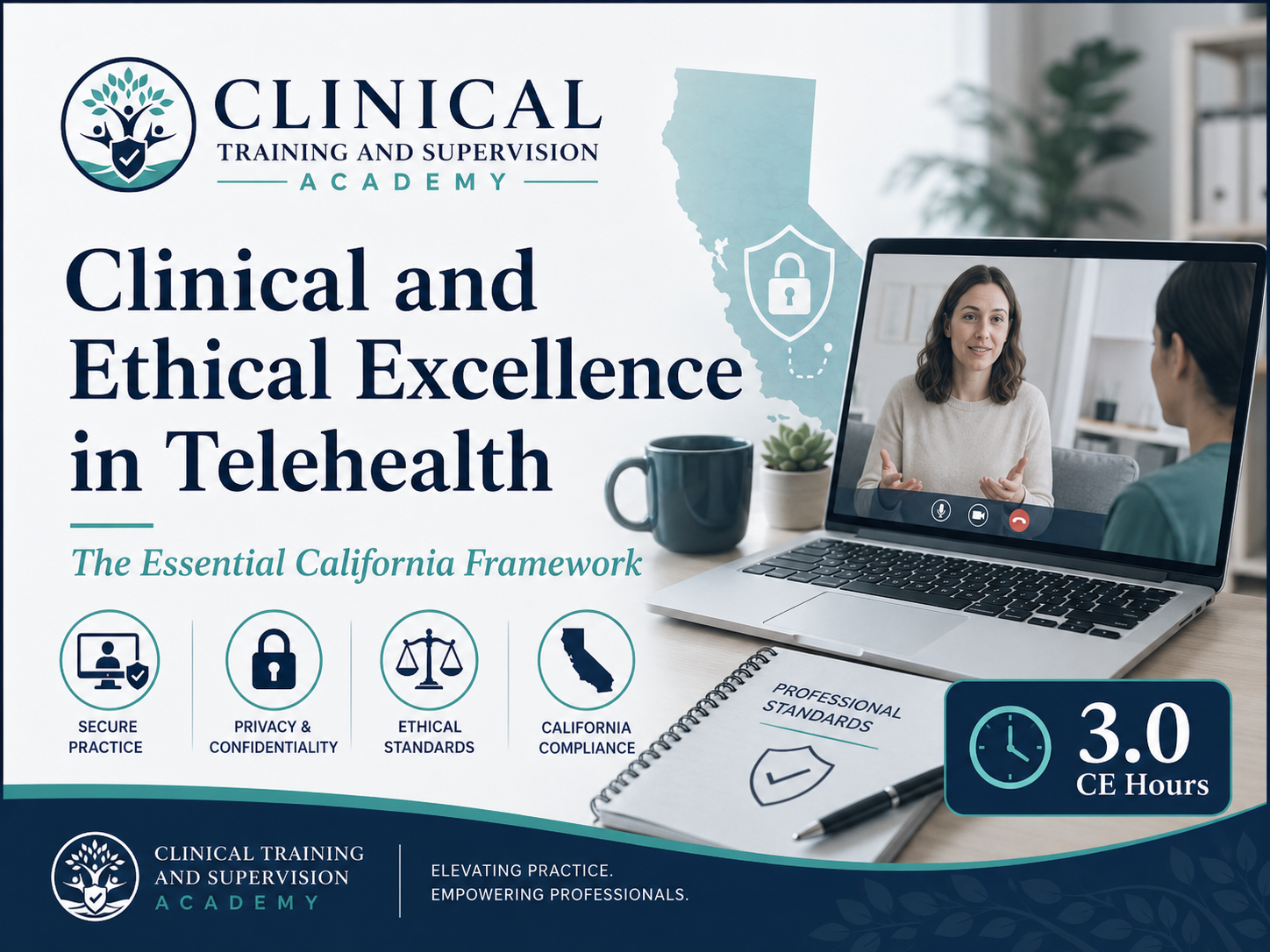
Clinical and Ethical Excellence in Telehealth: The Essential California Framework
Strengthen the legal, ethical, clinical, privacy, and crisis-response systems needed to provide safer and more effective telehealth services in California mental health practice.
Course Description
This three-hour asynchronous course provides California mental health professionals with a practical framework for delivering legally informed, ethically sound, and clinically effective telehealth services. Participants examine current California telehealth requirements, jurisdiction and interstate-practice concerns, informed consent, each-session identity and location procedures, telehealth appropriateness, crisis-response planning, electronic privacy and security safeguards, digital communication, professional boundaries, and technology-failure continuity.
Through realistic scenarios, knowledge checks, structured decision-making, and a downloadable clinical resource toolkit, learners strengthen the systems they use to protect client welfare, support continuity of care, document professional reasoning, and respond when remote practice conditions change.
Course Information
- Course Code: CTA-CE-002
- Course Classification: Foundational CE Course
- Course Level: Introductory to Intermediate
- Target Audience: LMFTs, LCSWs, LPCCs, and Registered Associates
- Instructional Method: Asynchronous Distance Learning
- CE Credits: 3 CE Hours (180 Minutes of Active Instruction)
- Presenter/Author: Candice Fuimaono, MS, LMFT
What Participants Will Learn
- Identify at least four California legal or ethical requirements governing telehealth initiation, informed consent, jurisdiction, and each-session safety procedures.
- Apply a telehealth intake and session-opening protocol that includes identity verification, present-location verification, appropriateness assessment, and documentation.
- Design a telehealth emergency-response plan that includes local resources, an emergency contact, present-location procedures, backup communication, and continuity steps.
- Identify at least three administrative, physical, or technical safeguards that protect electronic client information during telehealth services.
- Apply procedures for managing technology disruptions and electronic communications while maintaining privacy, continuity of care, and professional boundaries.
Key Topics
- California telehealth law and BBS practice standards
- Jurisdiction and interstate-practice verification
- Telehealth consent, initiation, and each-session procedures
- Identity and present-location verification
- Telehealth appropriateness and higher-risk planning
- Emergency resources, backup communication, and continuity
- Privacy and security safeguards for electronic client information
- Technology and vendor review, including BAAs when applicable
- Digital communication and professional boundaries
- Technology-failure response and documentation
Instructional Modules
Enroll in this course to unlock all modules and the final quiz.
-
1California Legal Foundations and Jurisdictional Boundaries60 min
Summary of Main Points
- California telehealth law and BBS practice standards
- Jurisdiction and interstate-practice verification
- Telehealth consent, initiation, and each-session procedures
-
2Intake, Identity and Location Verification, and Crisis Protocols60 min
Summary of Main Points
- Identity and present-location verification
- Telehealth appropriateness and higher-risk planning
- Emergency resources, backup communication, and continuity
-
3HIPAA Safeguards, Digital Privacy, and Professional Boundaries60 min
Summary of Main Points
- Privacy and security safeguards for electronic client information
- Technology and vendor review, including BAAs when applicable
- Digital communication and professional boundaries
- Technology-failure response and documentation
Course Completion Requirements
Complete all three instructional modules and required learning activities; earn at least 70% (18 of 25) on the final examination; complete the course-specific evaluation; and submit the completion attestation. Examination attempts are unlimited and there is no examination time limit. The certificate becomes available only after all requirements are satisfied.
Educational Notice
This course is educational and does not replace clinical judgment, supervision, legal consultation, emergency consultation, organizational policy, or verification of current laws and regulations. Requirements may change; clinicians remain responsible for confirming the rules that apply to their profession, setting, client location, and circumstances.
References
- Board of Behavioral Sciences. (2023). Statutes and regulations relating to the practice of marriage and family therapy, licensed clinical social work, and licensed professional clinical counseling. State of California.
- Maheu, M. M., Drude, K. P., & Hertlein, K. M. (2020). The telehealth professions: Principles and practices for mental health and substance use disorders. Springer Publishing Company.
- Zur, O. (2021). Digital ethics and telehealth in psychotherapy: Navigating the boundaries of remote care. Routledge.