
Advanced Suicide Risk Assessment: Evidence-Based Intervention and Ethical Documentation
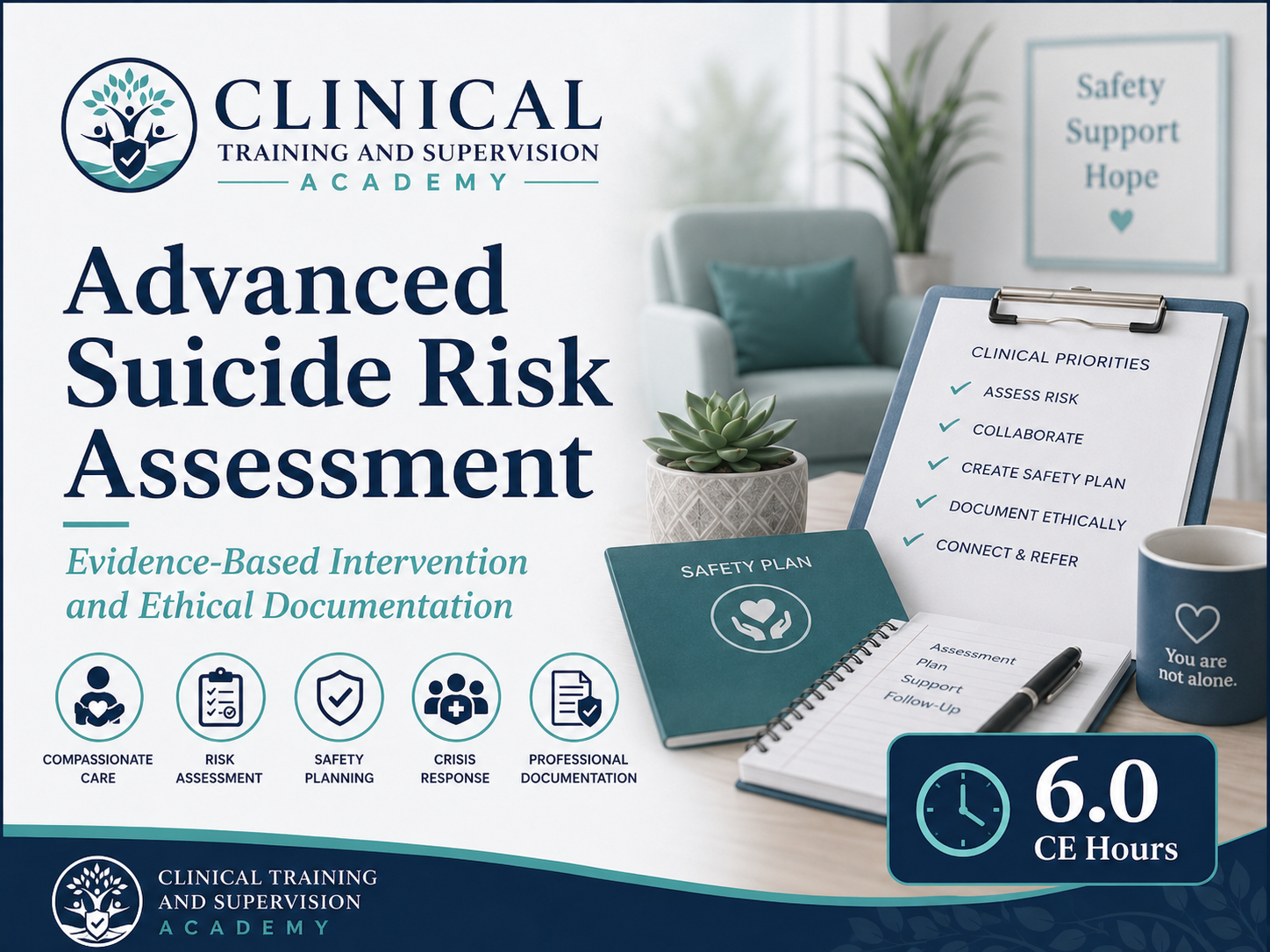
Strengthen clinical judgment in suicide-risk assessment, formulation, safety planning, escalation, documentation, and postvention. This six-hour asynchronous course helps California mental health professionals use structured tools appropriately, develop person-specific formulations, apply collaborative safety-planning and lethal-means-safety principles, navigate level-of-care decisions, and document high-risk care clearly.
Course Description
This course provides mental health professionals with advanced training in the assessment, formulation, management, documentation, and postvention of suicide risk across diverse clinical settings. Participants examine evidence-informed approaches to identifying warning signs and risk factors, conducting structured suicide inquiry, using the C-SSRS and SAFE-T appropriately, developing person-specific risk formulations, implementing collaborative safety planning and lethal-means safety, and responding to psychiatric emergencies.
Emphasis is placed on clinical decision-making, ethical responsibilities, California legal considerations, consultation, level-of-care decisions, continuity of care, and documentation practices that support client safety and professional accountability. The course also addresses clinician reactions, critical-incident support, postvention following suicide death, and professional recovery.
Course Information
- Course Code: CTA-CE-003
- Course Classification: Core Tier Continuing Education Course
- Course Level: Intermediate to Advanced
- Target Audience: LMFTs, LCSWs, LPCCs, and Registered Associates
- Instructional Method: Asynchronous Distance Learning
- CE Credits: 6 CE Hours (360 Minutes of Active Instruction)
- Presenter/Author: Candice Fuimaono, MS, LMFT
What Participants Will Learn
- Identify at least five warning signs, risk factors, or protective factors associated with suicide risk and distinguish chronic suicidal ideation, acute suicidal intent, and non-suicidal self-injury.
- Apply the Columbia-Suicide Severity Rating Scale and the SAFE-T framework to a clinical case and classify information needed for a comprehensive suicide-risk formulation.
- Prepare a collaborative six-step safety plan that includes warning signs, coping strategies, social supports, professional resources, and lethal-means safety.
- Identify three clinical or legal factors relevant to a California danger-to-self determination and select an appropriate crisis-response or level-of-care action.
- Write a suicide-risk documentation note that includes at least four elements supporting clinical rationale, consultation, intervention, and follow-up.
- Design a postvention and clinician-support protocol that addresses continuity of care, consultation, countertransference, secondary traumatic stress, and professional wellness.
Instructional Modules
Enroll in this course to unlock all modules and the final quiz.
-
1The Epidemiology and Phenomenology of Suicide60 min
Summary of Main Points
- National and regional suicide statistics
- Trends across demographic and clinical groups
- Mental illness, substance use, and suicide risk
- Psychosocial stressors and high-risk transitions
- Chronic suicidal ideation versus acute intent
- Non-suicidal self-injury versus suicidal behavior
- Continuum and context of suicide risk
-
2Standardized Assessment and Comprehensive Risk Formulation60 min
Summary of Main Points
- Importance and limitations of structured tools
- Columbia-Suicide Severity Rating Scale
- SAFE-T framework
- Warning signs, risk factors, and protective factors
- Assessment beyond intuition or a single score
- Risk formulation and clinical decision-making
- Translating findings into treatment and disposition decisions
-
3Moving Beyond No-Harm Contracts to Collaborative Safety Planning60 min
Summary of Main Points
- Limitations of no-harm or no-suicide contracts
- Evidence supporting collaborative safety planning
- Stanley-Brown Safety Planning Intervention
- Personal warning signs and internal coping strategies
- Social supports and environmental distractions
- Professional resources and crisis contacts
- Lethal-means safety and collaborative implementation
-
4Involuntary Evaluation, Hospitalization, and Legal Thresholds60 min
Summary of Main Points
- California Welfare and Institutions Code section 5150
- Danger-to-self considerations
- Clinical indicators supporting emergency evaluation
- When hospitalization may be clinically appropriate
- Coordination with mobile crisis, emergency departments, and law enforcement
- Voluntary alternatives and least-restrictive care
- Legal and ethical considerations involving minors
-
5Clinical Documentation, Consultation, and Liability Management60 min
Summary of Main Points
- Documentation of risk and protective factors
- Recording assessment findings and clinical rationale
- Incorporating standardized tools into progress notes
- Consultation and supervision documentation
- Interventions considered, selected, and declined
- Follow-up, continuity of care, and communication
- Defensible standards of care and risk management
-
6Postvention, Clinician Wellness, and Professional Recovery60 min
Summary of Main Points
- Clinical and emotional impact of suicide-related cases
- Response following attempts or suicide deaths
- Postvention, continuity of care, and communication
- Peer consultation and professional support
- Secondary traumatic stress and compassion fatigue
- Countertransference awareness and management
- Long-term clinician wellness and professional recovery
Course Completion Requirements
- Complete all required instructional modules and embedded learning activities.
- Earn a score of at least 70% on the final examination. Participants may repeat the examination until the passing score is achieved.
- Complete the course-specific evaluation, including a rating for each measurable learning objective.
- Submit the required course-completion attestation for asynchronous distance learning.
- A CE certificate is issued only after all completion requirements are satisfied.
Educational Notice
Educational material only. This course does not provide legal advice, determine whether any individual meets emergency-detention criteria, establish a universal standard of care, or replace clinical supervision, consultation, current law, employer policy, emergency services, or case-specific legal counsel.
References
- Boudreaux, E. D., & Camargo, C. A. (2021). Managing suicidal risk in the modern clinical setting: Tools for screening and stabilization. Oxford University Press.
- Bryan, C. J. (2022). Rethinking suicide: Why prevention fails, and how we can do better. Oxford University Press.
- Stanley, B., & Brown, G. K. (2020). Safety planning intervention: A brief intervention to mitigate suicide risk. Journal of Clinical Psychiatry, 81(2), 11-19.