
Child Abuse Assessment & Mandated Reporting
This asynchronous continuing education course provides structured clinical training in Child Abuse Assessment & Mandated Reporting. It is designed for LMFTs, LCSWs, LPCCs, LEPs, and Registered Associates and combines online text, instructional video modules, downloadable resources, case studies, and clinical…
Course Description
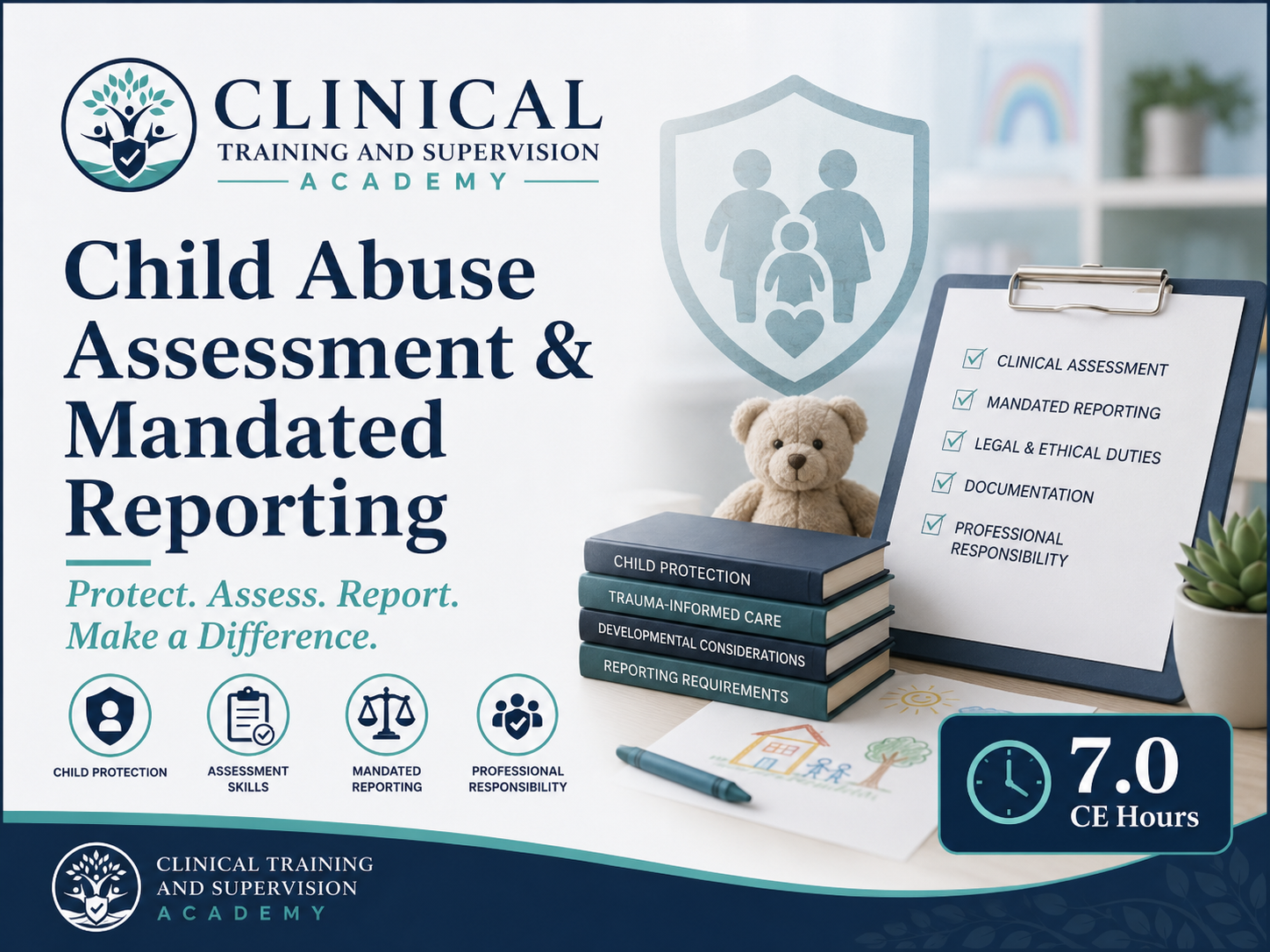
This asynchronous continuing education course provides structured clinical training in Child Abuse Assessment & Mandated Reporting. It is designed for LMFTs, LCSWs, LPCCs, LEPs, and Registered Associates and combines online text, instructional video modules, downloadable resources, case studies, and clinical application exercises.
Course Information
- Course Level: Intermediate
- Target Audience: LMFTs, LCSWs, LPCCs, LEPs, and Registered Associates
- Instructional Method: Asynchronous Distance Learning (online text, instructional video modules, downloadable resources, case studies, and clinical application exercises)
- CE Credits: 7 CE Hours (420 Minutes of Active Instruction)
- Presenter/Author: Candice Fuimaono, MS, LMFT
Educational Goals
- Strengthen the ability to recognize, assess, document, and respond to suspected child abuse and neglect.
- Enhance trauma-informed and developmentally responsive clinical practice with children and families affected by maltreatment.
- Improve application of California mandated-reporting requirements and reasonable-suspicion standards.
- Expand objective documentation and professional decision-making in complex child-protection situations.
- Increase confidence in managing caregiver reactions, ethical dilemmas, consultation needs, and post-report treatment responsibilities.
- Support child safety while preserving appropriate therapeutic boundaries and continuity of care.
What Participants Will Learn
- Identify at least six physical, behavioral, emotional, developmental, or disclosure-based indicators associated with child abuse or neglect.
- Select three developmentally appropriate assessment adaptations for infants, young children, nonverbal children, children with disabilities, or adolescents.
- Apply three non-leading response strategies when a child discloses possible maltreatment and distinguish clinical assessment from investigative interviewing.
- Prepare objective clinical documentation that includes observations, exact statements, clinical reasoning, actions taken, and consultation or reporting decisions.
- Explain the difference between reasonable suspicion and proof under California's Child Abuse and Neglect Reporting Act (CANRA).
- List the required sequence and timelines for verbal and written mandated reports in California.
- Select at least three post-report clinical, consultation, and risk-management strategies that support the child, family, and ongoing treatment.
Instructional Modules
Enroll in this course to unlock all modules and the final quiz.
-
1Foundations of Child Abuse Assessment60 min
Summary of Main Points
- Overview of child maltreatment in clinical practice
- Prevalence, risk factors, and developmental impact
- Trauma-informed assessment principles
- Professional responsibilities in child protection
- Role of mental health professionals in recognition and response
- Common misconceptions regarding abuse recognition and reporting
- Child safety, therapeutic care, and professional accountability
-
2Recognizing Physical, Behavioral, Emotional, and Disclosure Indicators60 min
Summary of Main Points
- Physical indicators of abuse and neglect
- Behavioral, emotional, and developmental warning signs
- Differentiating accidental injury from concerning presentations
- Trauma-related responses and changes in functioning
- Disclosure patterns, delayed disclosure, and recantation
- Clinical observation and documentation
- Application through case examples
-
3Special Populations and Complex Child-Protection Cases60 min
Summary of Main Points
- Infants and very young children
- Children with developmental disabilities or communication challenges
- Nonverbal children and limited disclosures
- Adolescent disclosure patterns and delayed reporting
- Domestic violence, caregiver substance use, and child safety
- Cultural considerations and bias awareness
- Advanced case conceptualization in high-risk situations
-
4Assessment, Documentation, and Child Disclosures60 min
Summary of Main Points
- Developmentally appropriate assessment approaches
- Responding to disclosures without leading or investigating
- Clinical assessment versus forensic interviewing
- Objective and defensible documentation
- Recording exact statements, observations, and clinical rationale
- Common documentation errors
- Consultation and decision-support practices
-
5California Mandated Reporting and CANRA60 min
Summary of Main Points
- Overview of the Child Abuse and Neglect Reporting Act
- Mandated-reporter responsibilities
- Reportable categories of abuse and neglect
- Reasonable-suspicion standards and reporting thresholds
- Verbal and written reporting timelines
- Reporting procedures and documentation
- Common legal misconceptions and practice errors
-
6Difficult Reporting Decisions and Ethical Challenges60 min
Summary of Main Points
- Managing uncertainty and incomplete information
- Caregiver resistance, anger, and requests for secrecy
- Confidentiality and informed-consent considerations
- Professional boundaries during investigations
- Cultural humility and bias awareness
- Ethical decision-making frameworks
- Consultation, supervision, and risk-management resources
-
7After the Report: Clinical Care and Professional Protection60 min
Summary of Main Points
- Supporting children after a mandated report
- Maintaining the therapeutic relationship
- Understanding investigative responses and procedures
- Collaboration with Child Protective Services and other agencies
- Post-report documentation and treatment planning
- Professional risk management and consultation
- Clinician self-care and emotional-impact management
Course Completion Requirements
- Complete all required instructional modules and embedded learning activities.
- Earn a score of at least 70% on the final examination. Participants may repeat the examination until the passing score is achieved.
- Complete the course-specific evaluation, including a rating for each measurable learning objective.
- Submit the required course-completion attestation for asynchronous distance learning.
- A CE certificate is issued only after all completion requirements are satisfied.
References
- California Department of Social Services. (2023). The California mandated reporter handbook. State of California.
- Cross, T. P., Mathews, B., & Jones, L. M. (2021). Improving the clinical response to child maltreatment: Legal frameworks and reporting protocols for mental health practitioners. Routledge.
- Mathews, B., & Bross, D. C. (2020). Mandatory reporting laws and children's rights: An international and comparative analysis. Springer Publishing.
- Myers, J. E. B. (2023). A practitioner's guide to child abuse and neglect (9th ed.). Sage Publications.
- Kellogg, N. D. (2021). The evaluation of suspected child physical abuse. American Academy of Pediatrics.