Alcoholism & Other Chemical Substance Dependency: Assessment, Treatment, Recovery, & Clinical Practice
This asynchronous continuing education course provides structured clinical training in Alcoholism & Other Chemical Substance Dependency: Assessment, Treatment, Recovery, & Clinical Practice. It is designed for LMFTs, LCSWs, LPCCs, LEPs, and Registered Associates and combines online text, instructional video modules,…
Course Description
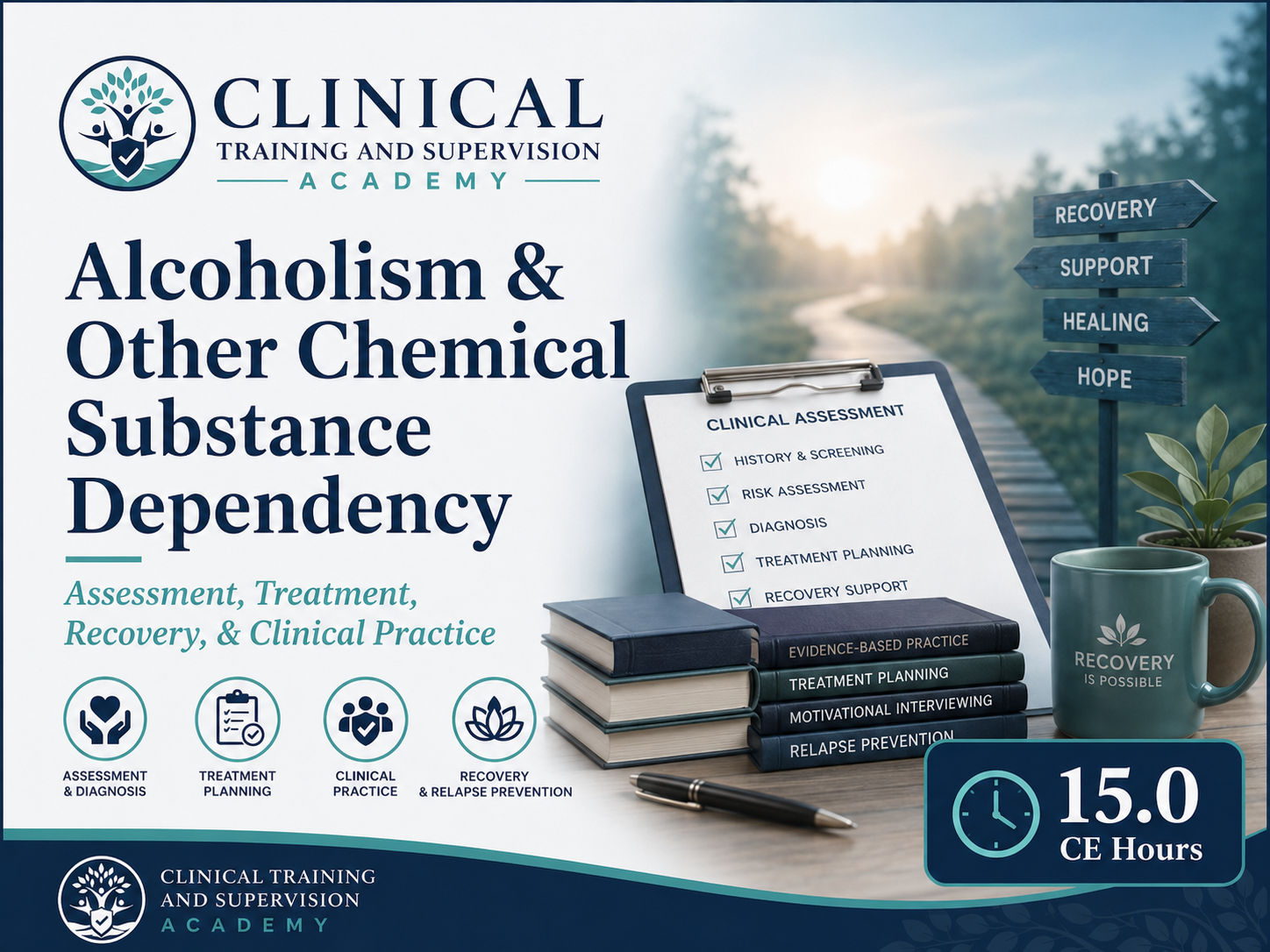
This asynchronous continuing education course provides structured clinical training in Alcoholism & Other Chemical Substance Dependency: Assessment, Treatment, Recovery, & Clinical Practice. It is designed for LMFTs, LCSWs, LPCCs, LEPs, and Registered Associates and combines online text, instructional video modules, downloadable resources, case studies, and clinical application exercises.
Course Information
- Course Level: Intermediate to Advanced
- Target Audience: LMFTs, LCSWs, LPCCs, LEPs, and Registered Associates
- Instructional Method: Asynchronous Distance Learning (online text, instructional video modules, downloadable resources, case studies, and clinical application exercises)
- CE Credits: 15 CE Hours (900 Minutes of Active Instruction)
- Presenter/Author: Candice Fuimaono, MS, LMFT
Educational Goals
- Strengthen an integrated understanding of the biological, psychological, social, environmental, and recovery-related factors associated with substance use disorders.
- Enhance clinical competence in substance-specific assessment, DSM-5-TR diagnosis, screening, referral, and level-of-care decision-making.
- Expand practical skill in Motivational Interviewing, Cognitive Behavioral Therapy, Contingency Management, harm reduction, treatment planning, and relapse prevention.
- Improve the integration of mental health and substance use treatment for clients with co-occurring conditions.
- Increase ethical and professional decision-making related to documentation, scope of competence, risk management, and clinician impairment.
- Support recovery-oriented care that respects multiple pathways to change and promotes client safety, engagement, and long-term wellness.
What Participants Will Learn
- Describe four biological, psychological, social, and environmental factors that contribute to the development or maintenance of substance use disorders.
- Identify the clinical effects, intoxication or withdrawal risks, and treatment considerations associated with at least five major classes of psychoactive substances.
- Apply DSM-5-TR criteria to determine the presence and severity of a substance use disorder in a clinical case example.
- Apply at least two evidence-based screening tools, such as the AUDIT, AUDIT-C, DAST-10, or CAGE-AID, and explain how the results inform referral and level-of-care decisions.
- Apply at least three Motivational Interviewing strategies to increase engagement and support behavior change.
- Select appropriate evidence-based interventions from Cognitive Behavioral Therapy, Contingency Management, harm reduction, and recovery-oriented care based on a client case.
- Prepare an integrated treatment and relapse-prevention plan that includes at least five components addressing clinical needs, co-occurring conditions, supports, risk, and continuing care.
- Identify four indicators of professional impairment and select appropriate consultation, documentation, referral, and public-protection responses.
Instructional Modules
Enroll in this course to unlock all modules and the final quiz.
-
1Foundations of Addiction Science60 min
Summary of Main Points
- Historical perspectives on addiction and the evolution of treatment
- Stigma, language, and common misconceptions
- Current prevalence and public-health considerations
- Biopsychosocial and environmental contributors
- Risk factors, protective factors, and recovery capital
- Substance use disorder as a chronic and treatable condition
- Recovery-oriented systems of care and multiple pathways to change
-
2Neurobiology of Addiction and Recovery60 min
Summary of Main Points
- Brain reward pathways, dopamine, and reinforcement
- Tolerance, withdrawal, craving, and neuroadaptation
- Executive functioning, decision-making, and behavioral control
- Effects of chronic substance use on brain and behavior
- Stress, learning, memory, and cue reactivity
- Neuroplasticity and recovery implications
- Clinical implications for engagement and treatment planning
-
3Alcohol Use Disorder60 min
Summary of Main Points
- Alcohol pharmacology and patterns of use
- Prevalence, risk factors, and protective factors
- DSM-5-TR diagnostic considerations
- Alcohol intoxication and withdrawal syndromes
- Recognition of medical emergencies, including delirium tremens
- Screening, assessment, and referral considerations
- Evidence-based treatment and relapse-prevention approaches
-
4Opioid Use Disorders60 min
Summary of Main Points
- Prescription opioid misuse, heroin, fentanyl, and counterfeit substances
- Opioid intoxication, withdrawal, and overdose recognition
- Naloxone education and overdose-response principles
- Medication for Opioid Use Disorder (MOUD)
- Harm-reduction strategies and public-health considerations
- Evidence-based treatment and recovery supports
- Clinical coordination and referral responsibilities
-
5Stimulants and Emerging Drug Trends60 min
Summary of Main Points
- Methamphetamine, cocaine, and other stimulant-related disorders
- Stimulant intoxication, withdrawal, and psychiatric complications
- Synthetic substances and designer-drug trends
- Polysubstance use and unpredictable interaction risks
- Vaping products and nicotine-related concerns
- Clinical assessment and treatment considerations
- Current trends and implications for prevention and care
-
6Cannabis, Sedatives, Hallucinogens, Inhalants, and Other Substance Classes60 min
Summary of Main Points
- Cannabis-related disorders and clinical considerations
- Sedative, hypnotic, and anxiolytic use disorders
- Hallucinogen- and inhalant-related concerns
- Nicotine and tobacco use disorders
- Substance-induced psychiatric symptoms
- Intoxication, withdrawal, and medical-risk indicators
- Referral, consultation, and scope-of-competence considerations
-
7DSM-5-TR Diagnosis and Clinical Formulation60 min
Summary of Main Points
- DSM-5-TR substance use disorder criteria
- Severity, remission, and controlled-environment specifiers
- Substance-induced disorders versus independent mental disorders
- Differential diagnosis and diagnostic uncertainty
- Medical, developmental, cultural, and contextual considerations
- Clinical formulation beyond the diagnostic label
- Documentation of diagnostic reasoning
-
8Screening, SBIRT, Risk Assessment, and Levels of Care60 min
Summary of Main Points
- Clinical interviewing and readiness-for-change assessment
- AUDIT, AUDIT-C, DAST-10, and CAGE-AID
- Screening, Brief Intervention, and Referral to Treatment (SBIRT)
- Assessment of overdose, withdrawal, suicide, and violence risk
- Treatment matching and level-of-care considerations
- Medical detoxification and emergency referral indicators
- Care coordination and documentation of referral decisions
-
9Motivational Interviewing and Engagement60 min
Summary of Main Points
- Motivational Interviewing spirit and core principles
- Open questions, affirmations, reflections, and summaries (OARS)
- Change talk, sustain talk, and ambivalence
- Engaging clients who are uncertain about change
- Developing discrepancy without confrontation
- Supporting autonomy and collaborative planning
- Applying Motivational Interviewing across stages of change
-
10Cognitive Behavioral Therapy and Contingency Management60 min
Summary of Main Points
- Functional analysis of substance use behavior
- Triggers, thoughts, emotions, urges, and consequences
- Cognitive and behavioral coping strategies
- Skill rehearsal and behavioral planning
- Contingency Management principles and applications
- Monitoring progress and reinforcing recovery behaviors
- Integrating interventions with client goals and context
-
11Treatment Planning, Relapse Prevention, and Continuing Care60 min
Summary of Main Points
- Collaborative and individualized treatment planning
- Measurable goals, objectives, and interventions
- High-risk situations, triggers, and early-warning signs
- Relapse-prevention and return-to-use response planning
- Recovery capital, social support, and continuing care
- Documentation of progress and treatment-plan revision
- Long-term recovery and transition planning
-
12Co-Occurring Mental Health and Substance Use Disorders60 min
Summary of Main Points
- Depression, anxiety, trauma-related disorders, and substance use
- Bipolar disorders, psychosis, and diagnostic complexity
- Suicide risk and substance-related disinhibition
- Differential diagnosis and symptom timelines
- Integrated assessment and treatment planning
- Coordination with medical and psychiatric providers
- Evidence-based approaches for co-occurring conditions
-
13Harm Reduction, Recovery Supports, and Multiple Pathways to Change60 min
Summary of Main Points
- Harm-reduction principles and clinical applications
- Overdose prevention and safer-use education
- Abstinence-based and non-abstinence treatment goals
- Mutual-help, peer support, and community recovery resources
- Medication-supported recovery and interdisciplinary care
- Client choice, cultural context, and recovery identity
- Continuing care and long-term wellness planning
-
14Professional Impairment and Therapist Substance Use60 min
Summary of Main Points
- Recognition of professional impairment
- Therapist substance use and fitness-to-practice concerns
- Self-assessment, wellness, and early intervention
- Consultation, supervision, and referral
- Public-protection responsibilities and professional accountability
- Recovery monitoring and return-to-practice considerations
- Lessons from California disciplinary cases
-
15Ethics, Documentation, Risk Management, and Clinical Decision-Making60 min
Summary of Main Points
- Ethical decision-making frameworks
- Scope of practice and scope of competence
- Documentation and informed-consent considerations
- Referral, consultation, and interdisciplinary coordination
- Risk management and duty-to-protect responsibilities
- Professional boundaries and accountability
- Application through clinical and disciplinary case analysis
Course Completion Requirements
- Complete all required instructional modules and embedded learning activities.
- Earn a score of at least 70% on the final examination. Participants may repeat the examination until the passing score is achieved.
- Complete the course-specific evaluation, including a rating for each measurable learning objective.
- Submit the required course-completion attestation for asynchronous distance learning.
- A CE certificate is issued only after all completion requirements are satisfied.
References
- American Psychiatric Association. (2022). Diagnostic and statistical manual of mental disorders (5th ed., text rev.).
- California Board of Behavioral Sciences. (2025). Statutes and regulations relating to the practice of marriage and family therapy, licensed clinical social work, licensed educational psychology, and professional clinical counseling.
- Inaba, D. S., & Cohen, W. E. (2019). Uppers, downers, all arounders: Physical and mental effects of psychoactive drugs (9th ed.).
- Marlatt, G. A., & Donovan, D. M. (Eds.). (2005). Relapse prevention: Maintenance strategies in the treatment of addictive behaviors (2nd ed.).
- McHugh, R. K., Hearon, B. A., & Otto, M. W. (2010). Cognitive behavioral therapy for substance use disorders. Psychiatric Clinics of North America, 33(3), 511-525.
- Miller, W. R., & Rollnick, S. (2023). Motivational interviewing: Helping people change and grow (4th ed.).
- Substance Abuse and Mental Health Services Administration. (2020). Treatment Improvement Protocol 35: Enhancing motivation for change in substance use disorder treatment.
- Substance Abuse and Mental Health Services Administration. (2024). Treatment Improvement Protocol 42: Substance use disorder treatment for people with co-occurring disorders.
- Substance Abuse and Mental Health Services Administration. (2024). Treatment Improvement Protocol 63: Medications for opioid use disorder.
- Substance Abuse and Mental Health Services Administration. (2023). Screening, brief intervention, and referral to treatment (SBIRT).